Saturday, 3 October 2020

September 2020


OK, we have done 2/3 of the year.  The second third has involved staying isolated and avoiding contact.  When you live rurally, as we do, that has not been as difficult as it might seem.  We avoided the town of Osoyoos all summer because of the tourists, and only did restrictive trips to town to buy groceries and other fundamentals.  (Amazon has become our best friend in order to get interesting things in the mail.....)  Our neighbours have been careful, and we have actually had the pleasure of a few modest social gatherings with them.  The weather has been extremely cooperative, with temperatures in the high 20’s for the first week of September.  With little rain for three months now (less than 15 mm in total), everything is going brown.


Brian started a men’s cycling group that meets Thursday morning to cycle uphill to a marvellous Mexican restaurant, Su Casa.  Su Casa is in the middle of nowhere on Highway 3 (Crowsnest Pass).  Denis, a French Canadian, and his wife Flor, a Mexican, started their restaurant about the time we moved here.  Flor’s Mexican food is to die for, and can’t be more authentic.  Denis, a true character, bakes cinnamon buns.  This is the sole purpose of the Thursday morning cycling group:  go to Su Casa, have coffee and a cinnamon bun, and come home and have a nice afternoon nap.  It doesn’t get any better than this.  (Denis did tiling beforehand, and our tile floors were a result of his work.  Nothing like being versatile.)


Highlights for us this month have been a couple of good hikes.

Near the beginning of the month, we drove up a rugged road to Mt. Kobau, a major mountain west of Osoyoos. (The road was an adventure in itself…)  There was a decent trail around the summit, and a good opportunity to see over to the US.

 There were also obviously burned out areas, and you could see fireweed and other plants starting to fill in at the ground level.  Not commonly known, but standing burnt trees are extremely unstable and are prone to snapping off with little provocation afterwards.  Walking through a burnt out area should be done with caution.


On our way back, we moved a few broken trees off the road.


We could still see smoke from hot spots from the Palmer fire in Washington. 


The bird’s eye view from the top was marvelous.  One enterprising couple was there with wine glasses in hand and a vintage to celebrate.  On one side we could see the valley leading to Osoyoos, while on the other side we could see the Similkameen Valley leading to Keremeos.


We didn’t see much in the way of critters other than a couple of monster grasshoppers, each  about 2“ long.


Mid-September featured about 12 days in a row of heavy smoke from US fires, leaving us in a grey zone where we didn’t go outdoors and kept the windows closed.  It wasn’t fun, but thinking about what the people were experiencing in the states made our situation much more tolerable.  We have had a very benign year this year regarding wildfires in BC.  The smoke still made for some good pictures.


On September 20, we went for a walk around Conkle Lake.  This provincial park is near to us (kind of, in that we can reach the turnoff on Highway e in 30 minutes.  The road to the lake is a lumber road, graveled.  The 25 km takes about an hour to travel.

 Conkle Lake is named after a local settler, and is a fascinating view into some unique terrain.

We started at a parking lot and followed the sign called “Trail Start”.  We’re not dumb!  There was a beautiful sandy beach here which obviously was ideal for dabbling.


The forest we travelled though was dense and shady.  Trees were festooned with Horsehair Lichen and occasional bright patches of Sulfur Lichen.


A major fire came through the area in 1931, destroying many of the old-growth larches.  Nonetheless, some remain as really large trees.  Mature trees here (both larch and pine) will survive a fire, because of thick enough bark at that at point to withstand the heat and continue to grow. 


On the west side of the lake, we travelled through forest that included cedars and other wet-loving plants.  There were little fall colours, although fireweed and other lower plants showed some colour.


On the other side of the lake, things changed completely.  The dampness was gone, to be replaced by grasses.  We could see across to the other side, where rock falls from unstable cliffs had pulled trees down.  On the east side, colour was starting to show from the Aspen Poplar and the Larches.


We had been told this route was 11 km, and we were ¾ around at this point.  It surely was going to be easy to finish.  Additionally, we could see the sandy beach from the shoreline.

NOT.

We started climbing, which clearly wasn’t taking us back to the sandy beach.  And we climbed and we climbed.  About 2/3 of the way up, we saw a sign saying “Exit”.  What?  We climbed some more (for a total of 400 feet) and eventually crossed a wooden bridge.

Park information had suggested a trail to a waterfall about 2 km from where we started.

Lo!  We were at the waterfall.  Although it was attractive, it was at low ebb.  We were sure spring would be an exciting time to be there.  Some rock slabs along the creed were indeed impressive.


There are lots of fallen trees here, but the dynamics seem to be different.  We speculate on rock falls from unstable cliffs and snow loads on younger trees.  Or maybe Mother Nature is creating natural teepee frames.


Another 2 km of relatively steep descent took us back to the parking lot where we could see the sun setting. 


Good day.  There is no photographic proof, but we saw a bald eagle, a garter snake, and a small frog.  Frankly we were a bit too tired to take pictures at that point.  Recuperation must follow.


Thanks for visiting.  Remember, Relish today, Ketchup tomorrow…..


Tuesday, 1 September 2020

August Blog


The Weather has been fine

               Despite a seemingly cold July, Summer came back with a vengeance.  We had a number of days in the low 30’s.  On August 17, Osoyoos recorded a record high of 38.3 degrees, but since it is generally about 5 degrees cooler on the mountain our high was 33.4.  We get used to this heat very quickly, and  are now finding it chilly when it is merely 18 degrees.

               As usual, summer is very dry.  We have received 5.4 mm of rain in July and 4.0 mm of rain in August, so much of the vegetation is now brown and dormant.  I don’t know how these plants make it year after year.

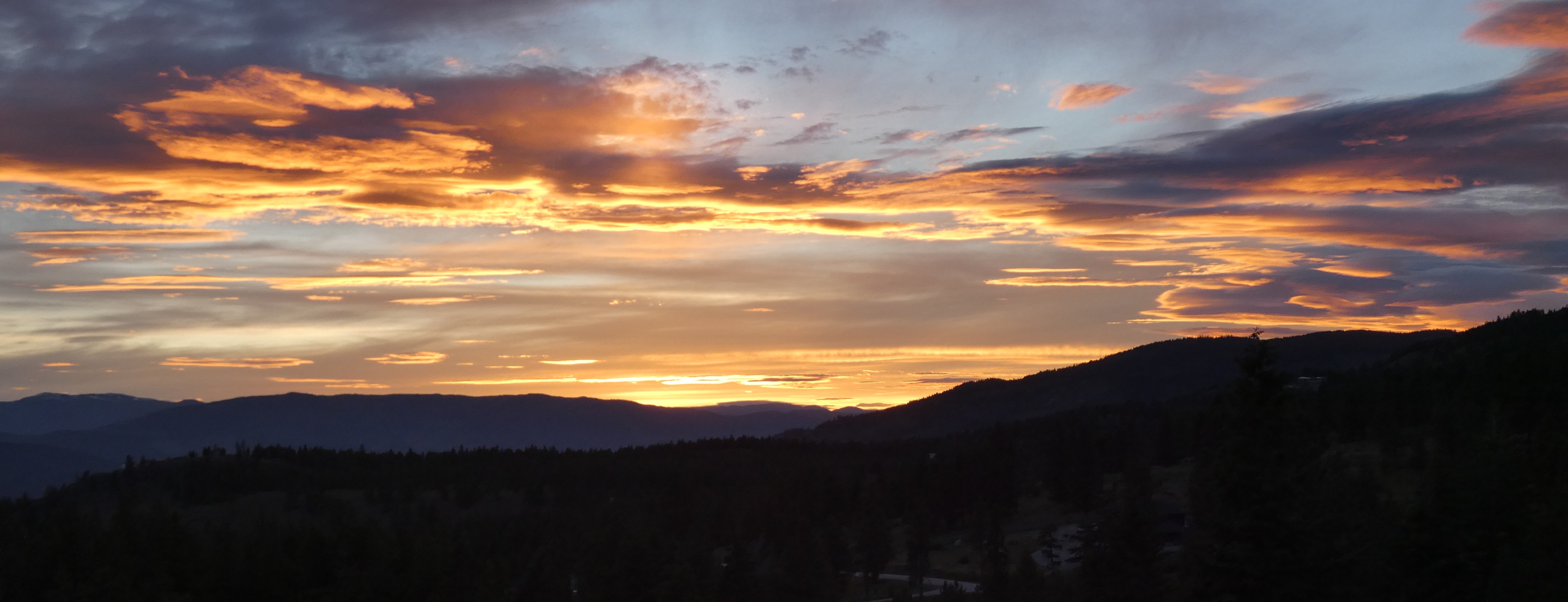
                One nice thing about August is the spectacular sunsets.


Fire Season:  The Palmer Fire

After a very quiet year for wildfires, things broke loose in mid-August.  The Mount Christie fire near Penticton garnered a lot of national attention, but that was well away from here.

The Palmer Fire was another story since it was right across the valley from us in Washington.  On August 18, we saw a huge plume of smoke in the afternoon, seemingly out of nowhere.  (On the left end of Lake Osoyoos below, you can see the American town of Oroville.) 


Unfortunately, winds picked up.

By nighttime, you could see the flames.


Within a day, the fire had grown to 6,000 acres; within 5 days, the fire had covered 18,000 acres.  The biggest concern was that it might reach the Canadian border, but as of the end of August 31 the fire was 96% contained.

In the first two days we found considerable amounts of ash on the balcony, with the first day showing blackened fir needles.

Even after the fire had moved through an area, you could see hot spots of smouldering as the fire continued within large stumps or roots.  This is as close as we ever want to get.


Adventures

Despite Covid-19 keeping us away from town as much as possible, we still have had a number of small but very enjoyable outings.

A Conservation Land trail is withing walking distance of our house; there is water running quietly through the valley.  It is like walking into a different country.  Everything is green and lush and you get to see lots of bird and beast activity.


We then drove west of here to cycle in the Similkameen Valley along with a pair of friends.  Our route was a quiet side road that wound through orchards and vineyards, and that is where we made a wonderful discovery.  The temperatures were in the low thirties when we discovered a self-serve fruit stand at a corner.  Some of the produce was free for the taking while other products were offered on an honour system.  This is a fabulous time of the year, with peaches at their peak and all kinds of vegetables available.  Apples will be next.  It really is tough living here.


The scenery in the area included some local hoodooos, which are not uncommon around here.


The Game Camera and Critters

We have only small things to report since it appears the house construction next door is keeping the deer away.  One of our first discoveries was that of a Western Terrestrial Gartersnake, also known as a wandering gartersnake.  We found Wandering Willie on our coffee deck one morning, to be followed by an appearance on our patio a few days later.  He’s just a little guy, about a foot long, but he is cute.


Some Ruffed Grouse showed up, but the only one who stuck around decided to become a guard grouse and stood on a rock in a dedication fashion to protect us.


In hopes of getting a few more shots of Wandering Willie, I put the game camera looking at our sidewalk, but only managed to get about 200 pictures of mice!

One, then two, then three…


A joyful reunion: on August 28 R2V2 was back! 

We had a family tragedy late July, when R2V2 developed robotic vacuum dementia.  First, he would go round and round in circles until finally beeping for help.  Then, he would get stuck in corners, again beeping desperately for help. With a phone call to tech support, it was determined he was eligible for warranty work, and he travelled to San Jose, California, for a spiritual rebirth.  A replacement arrived 5 days ago, and it is clear this is a younger and more capable model.  He doesn’t get stuck under the love seat, and he moves more quickly.  This clearly was a new entity, so he has been named BART for Born-again R Two.  We still call him R2 for short, of course.  He has been well-used since his return, especially for picking up wildfire ash.

August 31 Major weeding done

I promised I wouldn’t whine again about weeding, and I won’t.  After one final push yesterday, I have enough for a final trailer-load to go for disposal.  I developed a new tool for hauling weeds that sped up the process. 


Earlier this month, Brian took a picture of me in the grasses to show how tall everything grew this year.


One benefit of grubbing for weeds is that you find beautiful wildflowers like the Mariposa Lily.


There is one big invasive problem that can’t be dealt with by pulling, and that is that of Cheatgrass.  Cheatgrass was introduced in the 1800’s and is particularly a problem in dry regions. It’s everywhere. It goes dormant sooner that the native plants, and is at higher risk of burning in wildfires.  More immediately, it has the nastiest seeds.  Looking innocent at first, they have an oval end which tapers to a sharp point with a bristle.  The oval end penetrates smoothly into anything woven, but from that point it is very difficult to dislodge.  And like a porcupine quill, the bristle end hurts!  See my knee pads?  And that was after shaking the extras loose!  The only way to remove them is to pull them out backwards, which is way too time consuming.  And, I have to launder the affected garments separately; otherwise the seeds get embedded in everything and provoke pain in the most unlikely places.


Ah, well, there has to be a price for living in Paradise.


Thanks for visiting.  Stay safe and well.

Sunday, 2 August 2020

July 2020


Season Change

July is the month when we finally went from Spring to Summer.  On July 1, the high was 14.2 degrees; on July 31 the high was 34.9 degrees.  Osoyoos had a record high of 39.3 degrees on July 30 but we are lucky up on the mountain and generally experience temperatures 5-6 degrees cooler than that below.   Thank goodness!  However, we are now closing up the house at 9:30 am to avoid the heat inside.

Up to this point, we had had twice the normal amount of rain this year, with June featuring temperatures 5 degrees below normal.  That changed!  The grasses have turned brown and crispy, and a lightning storm yesterday started 15 spot fires.  We’ve been blessed with low wildfire activity this year, but that has changed in a heartbeat.

Covid-19 and BC

Although BC has been extremely good on holding the lid on Covid-19, tourist season has then wreaked havoc.  There were two private parties in Kelowna on Canada Day (featuring tourists from Vancouver and elsewhere) that have now resulted in 137 cases of infection and over 1000 people needing to self-quarantine.  This whole area depends on tourism, but we locals are finding it more of a threat than an improvement to the economy.  Downtown is crowded with larger groups of people, most not wearing face masks, and most appearing oblivious to the threat of infection.  They are on holidays from elsewhere and they seem to think it is not a problem.  Brian and I have restricted our visits to town and stores even more, and are looking forward to September for a reprieve.

Brian’s Bike and Kayak Month

The good weather has finally allowed Brian to get out on his bike, and he has put more than 600 km on it.  In addition, he was able to get out for a kayak trip on Jewel Lake—named very appropriately for its beauty.  He didn’t need to miss Georgian Bay, for there was a loon to greet him here instead.


WWWW—or W to the fourth Power

Or maybe it should be to the fifth power because I am going to assail you with the Wild Woman’s Weed Wrestling Whines.  I promise not to bore you further after this post, but I will vent now in hopes of gaining your generous sympathy.  Stay tuned for very very small W5 comments when I am more restrained later.

With two times the normal amount of rain this spring, every plant on this acreage flourished.  The good news was that we have had an enormous of number of wildflowers blooming this year.  The bad news is we have had an enormous number of weeds growing enormously.  I try to put in 14 hours of weeding per week, and that amount of time lends itself to wild fantasies coursing through my otherwise unoccupied head during those hours.

At the beginning, I considered that pulling out large weeds (like a 4 ½ foot thistle) meant that I could line up carcasses on the patio for admiration.  These honkers are huge.  I can pull 3 mustard plants or 3 knapweed plants, and fill a wheelbarrow.  Big deal—I could have a thousand wheelbarrows of work.

I thought I had pictures of the carcasses on the patio, but I couldn’t find them, so I will spare you.  Be thankful.

Last year I measured my successes in how many large bags of weeds I took in for disposal (100).  This year, I have found a kindly friend with a large trailer, and now I am counting trailer loads.  See my happiness.


 There will be a similar load in two weeks from this.

Speaking of the wildflowers found (still there is good news), Mariposa Lilies have started blooming, and there are more here than I have ever seen before.  The flowers are the size of a lime, but have little other than a thin stalk to the ground.  For a desert environment, they seem a bit miraculous.


The Joys of the Wapiti Pit

Our community has an incredibly fortunate deal with the local developer where they allow use of one of their gravel puts for community members to dump flammable yard waste for safe disposal during the fire season.  Pine cones, needles and pine branches are generally the first offering, but noxious weeds disposal is a great alternative. (The alternative for this stuff is to take it to landfill more than 40 km away one way, and bagging all noxious weeds in double plastic bags for disposal). Volunteers (me and our FireSmart Committee) monitor access to the Wapiti pit every second Saturday  through the summer season, and at the end of the season, generally after the first snow flies, the local volunteer fire department has a wonderful time burning off the debris (they really are arsonists,) and then monitoring the site afterward for hot spots.  Last year we accepted 174 loads of debris: this year we are already past 350 with four weekends to go.


Critter Watch

With the feeders down for the bears, I have far less sightings, but there are still highlights. 

The first batch of wrens have fledged and the parents are obviously bringing food to another clutch.

California quail have shown up on the patio and driveway, although I haven’t been quick enough to catch pictures.

We have been treated to aerial displays of Common Nighthawks this last week—the first for me.  They are elegant fliers, but their family name of Goatsuckers seems a bit weird.

We had a week snake on our coffee deck—not sure what kind.


The Month Upcoming


It is so hard to believe it is August already, and I know we are all experiencing different degrees of constraint due to Covid-a19.  We hope this finds you all well and safe.